Category Archives: Behavioral Forensics

Politics, Deception and Fraud: Unrelated or Close Cousins?

We hang the petty thieves and appoint the great ones to public office.
~Aesop

Answering a Question

Northwestern University has a Masters in Public Policy and Administration program and this program has a comprehensive course on the finance. Over the past year I have been a guest lecturer on fraud. As the year reached completion, the elections were of interest to Bob Kiely a co-leader of the course and City Manager of Lake Forest Illinois. The most recent course, in fact, had the fraud lecture following the national and local elections by exactly one week. Professor Kiely wondered: “How did the promises made by elected officials compare and contrast with those of fraud? “

In our text, The A.B.C.s of Behavioral Forensics, regarding the question of breaking the law, we use a continuum around psychopathy we discuss a novel observation:  “subclinical psychopathy”. Subclinical denotes the person can have some shared behaviors of a psychopath while not completely crossing over into what is described by the layman as a “monster”.

Subclinical psychopathy might explain what happens when people deceive or are caught outright telling lies in politics. I used two fictional characters: Mr. Smith who never tells a lie and “straightens up” politics through the force of his will and good intentions. On the other end, I used Mephistopheles, one of many classical iterations of the devil, or the “king of lies” who promised Faust what every he wanted in exchange for his soul.  Using the standard definition of fraud:  one who, embracing all multifarious means which human ingenuity can devise, (takes) advantage over another by false suggestions or by suppression of truth, and includes all surprise, trick, cunning, dissembling, and any unfair way by which another is cheated. . . .. (adapted from Black’s Law Dictionary) we stepped into what became a pretty easy case to make that political promises are pretty close to, if not flat out, fraudulent.

A politician is a fellow who will lay down your life for his country.
~Tex Guinan~

This led to a discussion around the promises of politicians. There were many that were concerning, and recent:

  • The Quincome tax: a tax by Illinois Governor Quinn that was promised to be temporary, but given the revenue shortfall in Illinois, it was obvious to most observers that it must become permanent – thus breaking the promise.
  • The teachers’ Union highly risky speculation of their pension in auction rate debt. From the Chicago Tribune, as the Mayor scolded the Union for taking too much risk with borrowing, noted their report (November 7, 2014) found that CPS’ 2003-07 issuance of $1 billion in risky auction-rate debt paired with interest-rate swaps will likely cost the district $100 million more than traditional fixed-rate bonds would have.
  • The challenger to Mitch McConnell who claimed as a Democrat she had not and would not vote with the President who was also a Democrat.  

Politics is the gentle art of getting votes from the poor and campaign funds from the rich, by promising to protect each from the other.

~Oscar Ameringer~

Lies, Damn Lies, and Political Ads

Then, we reviewed with the class recent negative advertisements in which small disclaimers are made at the end of highly provocative ads, or groups with known biases are supporting candidates but do so in clandestine, untraceable ways. In addition, how is the American Public served when the accounting for something as expensive as the Global War on Terror is not placed formally into the budget? In terms of tactics, our fraud blog team (Bigelow) suggested the classic tactic of what he called “pivoting” in which politicians refuse to answer a pointed question and instead ask a favorable question about a non-issue. In the class we used: You may be curious about my history as a sexual predator, but the American people are really curious to know is why is congress not doing anything to help the middle class – I promise to shake up the congress and bring about real change.

Politicians are the same all over. They promise to build a bridge even where there is no river.
~Nikita Khrushchev~

As a class, we revisited classic accounting techniques that are known to be used to cover up fraudulent transactions:

Masking: Failing to record or disclose an expense or a liability.

Dazzling: Disclosing information in the footnotes to the statements rather than in showing it in the body of the text.

Decoying: Emphasizing legal issues (blind alleys) that after a close examination turn out to be immaterial or handled appropriately.

Repackaging: Changing the descriptions or labels that characterize economic entities or reframing issues to maliciously justify the use of favorable accounting procedures.

Mimicking: Creating fictitious transactions or transactions without substance.

Double play: Improperly applying general accepted accounting principles to an item that is not individually material.

These known tactics that serve to camouflage fraud do have ties to electioneering:

  • How does Quinn’s promise to have a short-term temporary tax that became a permanent tax fit with these tactics?
  • How does the “off the books” financing of the wars in Afghanistan and Iraq fit with these tactics: is this “Masking”, “Dazzling” or something else?
  • What of the vague or later proven false negative advertisements? Is this “Dazzling”?
  • What of the false accusations or inferences (“Soft on crime”, “sending jobs overseas”, etc), are they “Mimicking?”
  • What of organizations that extend beyond US borders are influenced by local politics including corrupt officials?

Political electioneering is an ugly side of democracy that has been a concern since the birth of the Union. Washington in fact was famously critical of the idea of political parties and urged them to not be created.  It undermines trust of government and harms the overall confidence in a democratic process.

Implications

Municipal organizations do not exist in a Milton Friedman market-place as do privately owned organizations.  This is important to emphasize because they have no back up. If they fail, there are not other “competitors” that can fill in for their role: they create an environment for which it is safe to have markets in the first place. In terms of finance in particular, governments are different than private industry – they must be more conservative in terms of investing their financial resources.

Municipal Organizations, too, are composed of human beings who can be defrauded. In fact, subsequent to the course, Downers Grove, a generally well-run community outside of Chicago, was a victim of a significant fraud scheme. According to the Tribune: Downers Grove recently announced that $587,000 of its money is being withheld by the Illinois Metropolitan Investment Fund as a fraud investigation continues. The story goes on to note that this suburb financial troubles are part of a larger fraud scheme orchestrated by Nikesh A. Patel. Using an intermediary, Nikesh created fake documentation that ultimately were used or adapted in a total of $150M of bad loans.  The predatory fraudster discussed in our class had come to life in the real world. Trust but verify, a central tenant of accounting had been ignored.

In the end, the administrators, the often ridiculed “government bureaucrats”, are essential to our government, and thus our market places staying as well functioning as possible.

Join us for more insights into behavioral forensics (behind fraud and similar white collar crimes) from the authors of ABCs of Behavioral Forensics (Wiley, 2013): Sri Ramamoorti, Ph. D., Daven Morrison, M.D., and Joe Koletar, D.P.A., along with Vic Hartman, J.D.  These distinguished experts come from the disciplines of psychology, medicine, accounting, law, and law enforcement to explain and prevent fraud.  Because we are inspired to bring to light and address the fraud problems in today’s headlines, we encourage our readers to come back and revisit us regularly at BringingFreudtoFraud.com.
DOES A LEOPARD CHANGE ITS SPOTS? (NEW CASE REPRISE!)

(By Jack Bigelow) An article in the October 29 New York Times describes a pattern of what is believed to be a series of broken promises (to be good) among big banks caught in illegal transactions. The article, authored by Ben Protess and Jessica Silver-Greenberg, describes the pattern as the “Wall Street equivalent of a parole violation.”
The article makes specific references to reopened or potentially reopened investigations of Standard Chartered (“at risk of becoming Exhibit A of corporate backsliding…”), Bank of Tokyo-Mitsubishi UFJ, Barclays, and UBS. Prosecutors are apparently realizing that current punishment strategies fall short in preventing further wrong-doing. Also implicated are consultants (PricewaterhouseCoopers is named) suspected of compromising “independence” in assessing the scope of wrongdoing to favor the firms (including defense lawyers) paying their fees.
The typical case goes like this:
• Investigation discloses illegalities;
• Prosecutors agree to suspend charges if bank pays a fine and promises to behave;
• The magnitude of the wrongdoing (hence the use of consultants to determine it) drives the size of the fine;
• The fine is paid, the wrist is slapped, the promise is made;
• And it’s back to business as usual.
And apparently, “as usual” can sometimes mean more transgressions. It is, as the article describes it, “a cycle of misbehavior …difficult to break,” blamed by regulators and prosecutors on a culture that puts profit over compliance. The book, “A.B.C.s of Behavioral Forensics” would label that culture “a bad crop (rather than just a bad apple or bushel).”
I read the article with growing rage that the execution of justice just isn’t taking place.
Several posts concerning the implications and behavioral forensics in this sordid state of affairs will follow. And the first will address one element of justice.

Join us for more insights into behavioral forensics (behind fraud and similar white collar crimes) from the authors of ABCs of Behavioral Forensics (Wiley, 2013): Sri Ramamoorti, Ph. D., Daven Morrison, M.D., and Joe Koletar, D.P.A., along with Vic Hartman, J.D.  These distinguished experts come from the disciplines of psychology, medicine, accounting, law, and law enforcement to explain and prevent fraud.  Because we are inspired to bring to light and address the fraud problems in today’s headlines, we encourage our readers to come back and revisit us regularly at BringingFreudtoFraud.com.

NIXON: LESSONS FROM 40 YEARS AGO

(Repeat of a LinkedIn Posting of August 14: Nixon Resignation @ 40: Lessons for the Risk Officer on Deception, Caveat Emptor and Politics)

 https://www.linkedin.com/pulse/article/20140814204036-5071179-linkedin-and-nixon-deception-caveat-emptor-and-politics

(By Daven Morrison, MD)Richard Nixon resigned as President 40 years ago. His presidency, his personality and his actions mark a low point in Americans’ trust of leadership. Only a few years before, his signature had been planted on the moon with three astronauts and the American flag.

An incredible fall from grace.

How was he able to deceive so many about his illegal actions and what does it say about a Democracy? The implications matter for those who are concerned about those in power and how they impact putting an organization at risk. What happened with Nixon?

Without a doubt, deception played a role.

As my co-author and friend, Joe Koletar adeptly points out, we are all engaging in deception: men and women adjust their attire to deceive: to look taller, thinner, younger – more attractive. As a former senior executive in the FBI and an experienced fraud investigator for major accounting firms, Dr. Koletar knows it is easy to stand outside the question of deception and reassure ourselves that we don’t do it. But we all do . . .

We all use deception to gain advantage but also for protection as sometimes being too direct and “open” can get one hurt. Less commonly than how we dress, we deceive to avoid answering the direct question from a spouse or superior. Perhaps the most ethical was when a disguised Athanasius was being pursued and was discovered by those seeking to harm him. When asked where Athanasius was, Athanasius himself replied: “he is not far from here”. This can cause problems for the leaders of an organization as they may be quite close to a danger or threat, and yet the employees may be too fearful to sound an alarm.

In the marketplace we can be victims of deception. Thousands of people are deceived by “anti-aging” or virility products to the tune of billions of dollars. Deception also happens in the marketplace of jobs in interviews and on resumes. It likely happens on LinkedIn. And when there is enough money we are even duped into not seeing significant financial and even physical harm. The profession of medicine has known cigarettes cause cancer for almost a century now, yet we still sell them to people. Caveat emptor – or buyer beware is the classic precaution that excuses this behavior in the marketplace. This leaves employees who work in slippery organizations or industries also too fearful to alert leadership of problems.

What is perhaps most intriguing is: what is happening when the people (the greek “demos”) are deceived by elected officials? When we are deceived – even conned – much of the responsibility is on them. Yet some of it also lies on us as members of the democracy: the demos.

The course, Public Finance for Public Administration, offered at Northwestern had me present ideas on fraud. In their course, the professor, Bob Kiely City Manager of Lake Forest Illinois, wondered with his students about fraud. They asked: Beyond those who seek to commit financial fraud, where else does it exist? And how much of what politicians promise moves beyond deception into outright fraud? They felt there was a thin line that was often crossed.

In the case of Nixon, it was sufficient for the demos to say: “Enough!”

And Nixon was gone.

BRINGING FREUD TO FRAUD: UNDERSTANDING THE STATE-OF-MIND OF THE C-LEVEL SUITE/WHITE COLLAR OFFENDER THROUGH “A-B-C” ANALYSIS

This research was funded by the Institute for Fraud Prevention at West Virginia University of which Dr. Sri Ramamoorti was a Board member representing Grant Thornton LLP.

In this paper we use a primarily “behavioral lens” (cf. Ramamoorti, 2008; Ramamoorti & Olsen, 2007) to try to understand the state-of-mind and motivations of the C-level suite/white collar offender before, during, and after the perpetration of management fraud. We offer a useful conceptual approach called “A-B-C Analysis” to understand the incidence of fraud from individual and group perspectives, as well as more macro-oriented, cultural/contextual levels.

It is our hypothesis that fraud occurs either because of an individual criminal’s calculated/intentional betrayal of trust, a duo or team of “bad boys” who push ethical envelopes, and/or an organizational/social/national culture of passivity, indifference or accommodation that is tantamount to condoning such behaviors. We have called it the Bad Apple, Bad Bushel, or Bad Crop Syndrome: the so-called ABCs of white collar crime. Our interdisciplinary review of the literature, spanning (social) psychology, sociology and criminology, psychoanalysis and psychiatry, and anthropology, as well as our collective experience as practicing fraud examiners, investigators and consultants, have yielded some rich insights including that:

(1) Motivation for Fraud is Under-Hypothesized in Extant Literature: The motivation for fraud is under-hypothesized by the so-called “fraud triangle” consisting of perceived opportunity, perceived pressure, and rationalization (ACFE Fraud Examiners Manual, 1995; Cressey, 1953), and that there exist other motivations such as those based on “fraudster’s emotions” (e.g., revenge, social status comparisons, “crimes of passion” etc.), mastery of a situation or technique (e.g., a “catch-me-if-you-can” game), “self interest or group interest,” “noble cause corruption,” etc. This expanded set of cognitive, conative, affective, and other motivational variables underlying the perpetration of fraud is better accounted for by psychologist Michael Apter’s reversal theory (Apter, 1997, 2001, 2007a & 2007b). Fraud is frequently committed by manipulating human emotions.

(2) Standard Legal Definition of Fraud is Undesirably Narrow: The present legal definition of fraud as including “intent” or “scienter” as a key element may be undesirably narrow and constraining in adequately addressing the fraud problem; after all, you cannot “improve a (fraud detection) process without first understanding it.” This finding has potentially significant future consequences for not only re-appraising the standard definition of fraud (e.g., Black’s Law Dictionary, 1979) but also for criminology and law enforcement. We need a richer vocabulary and a deeper understanding of the underlying behavioral motivations for white collar crime.

(3) Unpacking “Greed” has Explanatory Value: There is considerable value to unpacking the common sense explanation for fraud, viz., greed, pure and simple. Without further delving into the meaning of the folk psychology term, “greed,” why it manifests itself in different ways, in different times and in different cultures, it can only be called “labeling” and naming something does not and cannot constitute a valid and credible explanation. In this connection, the research stream in social psychology on “counterfactual thinking and reasoning” appears to have considerable explanatory promise and must be further explored (see Roese & Olson, 1995).

Towards the end of the paper we provide a list of research questions that could be useful to academic researchers in crafting a responsive research agenda that exploits insights from the behavioral sciences. Two appendices deal with special topics: Appendix 1 illustrates the value of taking an evolutionary psychology approach; Appendix 2, “Greed Takes the Blame,” is a provocative editorial that explores “greed” as the prevailing conventional wisdom in accounting for fraud; and Appendix 3 suggests that academia is recognizing there may be more to finance than just rigorous economic foundations, incorporating behavioral insights is inexorable.

Click here to download the IFP White paper Bringing Freud to Fraud

Click here to download the IFP White paper Bringing Freud to Fraud

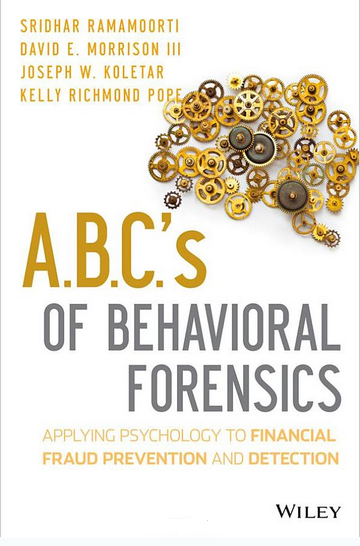
A.B.C.’s of Behavioral Forensics: Applying Psychology to Financial Fraud Prevention and Detection

Get practical insights on the psychology of white-collar criminals—and how to outsmart them

Understand how the psychologies of fraudsters and their victims interact as well as what makes auditors/investigators/regulators let down their guard. Learn about the psychology of fraud victims, including boards of directors and senior management, and what makes them want to believe fraudsters, and therefore making them particularly vulnerable to deception. Just as IT experts gave us computer forensics, we now have a uniquely qualified team immersed in psychology, sociology, psychiatry as well as accounting and auditing, introducing the emerging field of behavioral forensics to address the phenomenon of fraud.

ABC Book Cover Page

Ever wonder what makes a white-collar criminal tick? Why does she or he do what they do? For the first time ever, see the mind of the fraudster laid bare, including their sometimes twisted rationalizations; think like a crook to catch a crook! The A.B.C.’s of Behavioral Forensics takes you there, with expert advice from a diverse but highly specialized authoring team of professionals (three out of the four are Certified Fraud Examiners): a former accounting firm partner who has a PhD in psychology, a former FBI special agent who has been with investigative practices of two of the Big Four firms, an industrial psychiatrist who has worked closely with the C-level suite of large and small companies, and an accounting professor who has interviewed numerous convicted felons. Along with a fascinating exploration of what makes people fall for the common and not-so-common swindles, the book provides a sweeping characterization of the ecology of fraud using The A.B.C.’s of Behavioral Forensicsparadigm: the bad Apple (rogue executive), the bad Bushel (groups that collude and behave like gangs), and the bad Crop (representing organization-wide or even societally-sanctioned cultures that are toxic and corrosive). The book will make you take a longer look when hiring new employees and offers a deeper more complex understanding of what happens in organizations and in their people. The A.B.C. model will also help those inside and outside organizations inoculate against fraud and make you reflect on instilling the core values of your organization among your people and create a culture of excellence and integrity that acts as a prophylactic against fraud. Ultimately, you will discover that, used wisely, behavioral methods trump solely economic incentives. With business fraud on the rise globally,The A.B.C.’s of Behavioral Forensics is the must-have book for investigators, auditors, the C-suite and risk management professionals, the boards of directors, regulators, and HR professionals.

  • Examines the psychology of fraud in a practical way, relating it to aspects of fraud prevention, deterrence, detection, and remediation
  • Helps you understand that trust violation—the essence of fraud—is a betrayal of behavioral assumptions about “trusted” people
  • Explains how good people go bad and how otherwise honest people cross the line
  • Underscores the importance of creating a culture of excellence and integrity that inoculates an organization from fraud risk (i.e., honest behavior pays, while dishonesty is frowned upon)
  • Provides key takeaways on what to look for when hiring new employees and in your current employees, as well as creating and maintaining a culture of control consciousness
  • Includes narrative accounts of interviews with convicted white-collar criminals, as well as interpretive insights and analysis of their rationalizations
  • Furnishes ideas about how to enhance professional skepticism, how to resist fraudsters, how to see through their schemes, how to infuse internal controls with the people/behavioral element, and make them more effective in addressing behavioral/integrity risks
  • Provides a solid foundation for training programs across the fraud risk management life cycle all the way from the discovery of fraud to its investigation as well as remediation (so the same fraud doesn’t happen again)
  • Enables auditors/investigators to engage in self-reflection and avoid cognitive and emotional biases and traps that lead to professional judgment errors (e.g., overconfidence, confirmation, self-deception, groupthink, halo effect, availability, speed-accuracy trade-off, etc.)

Ever since the accounting scandals surrounding Enron and WorldCom surfaced, leading to the passage of the Sarbanes Oxley Act of 2002, as well as the continuing fall out from the Wall Street financial crisis precipitating the Dodd-Frank Act of 2010, fraud has been a leading concern for executives globally. If you thought you knew everything there was to know about financial fraud, think again. Get the real scoop with The A.B.C.’s of Behavioral Forensics.

You can get your copy from amazon by clicking the below link:
http://www.amazon.com/A-B-C-s-Behavioral-Forensics-Psychology-Prevention/dp/1118370554